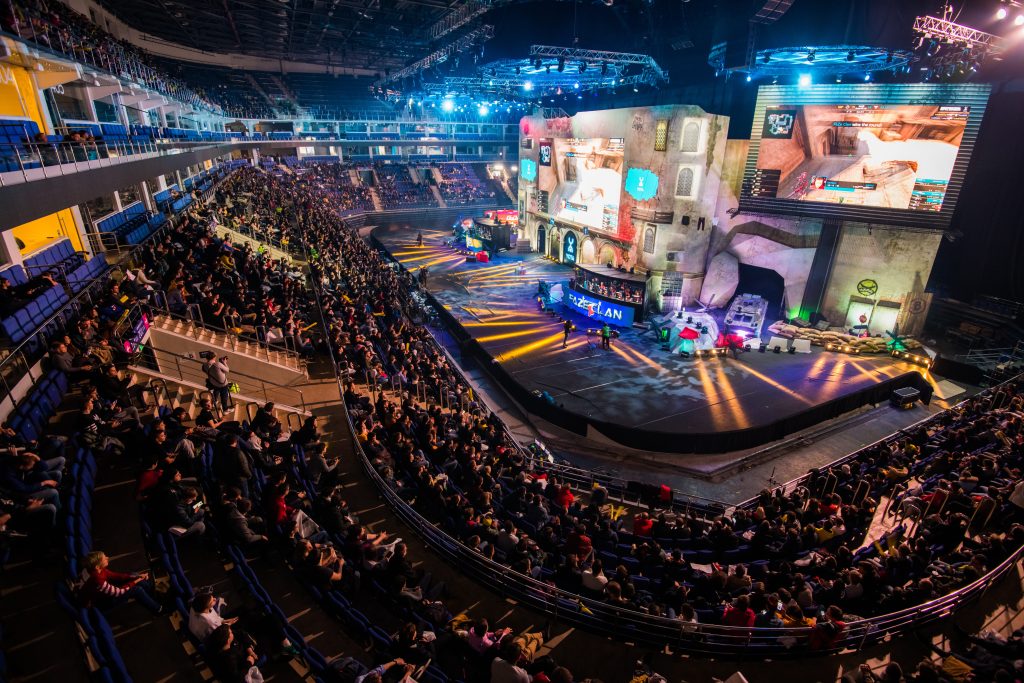
Step behind the screen and become the driving force behind the global esports scene—a massive global phenomenon where professional gamers and teams compete in highly organized tournaments for multimillion-dollar prize pools. This project-based qualification transforms students into a fully functional media production crew, teaching the essential skills needed to plan, produce, and broadcast professional-level live esports tournaments.
Designed primarily for school students aged 15–17, this course teaches the essential skills needed to plan, produce, and broadcast professional-level live esports tournaments. Over a 10-to-12-week duration (approximately 40–60 hours of instruction and practical work), the curriculum structures learning around the execution of a real, live-streaming capstone event, such as a school-wide or inter-class tournament. Students gain hands-on experience in every critical industry role—from technical director and graphics designer to commentator and producer—acquiring highly transferable skills in digital media, teamwork, problem-solving, and communication.
The training is delivered via a flexible hybrid model:
Instructor-Led Classroom Training: Hands-on technical workshops, control room simulations, live practical drills, and the execution of the live capstone event.
Online e-Learning: Virtual software mastery (OBS Studio), digital content creation, video asset management, stream statistics analysis, and platform integration (Twitch and YouTube).
This introductory subject establishes the foundational operational and structural frameworks required to bring an esports event to life. Students begin by exploring the global esports landscape, comparing the anatomy of massive professional events to local, school-level competitions. Through collaborative planning sessions, the class acts as a production crew to establish a definitive event strategy, which includes mapping out the tournament’s vision, scope, target audience, rule sets, and game selection. This subject also guides students through their first hands-on technical steps, introducing the core layout of OBS Studio, establishing Work Health and Safety (WHS) protocols for setting up hardware workstations, and evaluating industry-standard streaming networks like Twitch and YouTube.
Learning Outcomes:
In this subject, students transition into creative designers to build the distinct visual and aesthetic identity of their upcoming broadcast. The curriculum explores the fundamentals of digital branding, teaching students how to synthesize custom logos, color palettes, and comprehensive style guides that remain legally compliant with copyright and content licensing protocols. Using a project-based design brief, students learn to navigate digital editing suites to produce professional media assets such as static overlays and webcam frames. Additionally, students examine the technical and psychological design principles behind broadcast HUDs, learning how to configure stream widgets, browser sources, and live-updating scoreboard displays.
Learning Outcomes:
This subject dives deeply into the physical and digital architecture of broadcast engineering, focusing on studio signal flow and control room operations. Students trace the path of media data as it routes from gaming stations, through physical capture cards, and into a dedicated production computer. Practical lessons walk students through standard “Bump In” procedures, teaching them safe manual handling techniques while organizing hardware components using HDMI, USB, and XLR cabling. The curriculum places a strong emphasis on professional audio mixing, instructing students on microphone techniques, gain staging, software noise filters, and sync delays. Finally, students master complex multi-source scene management in OBS Studio and configure hotkey shortcuts to quickly execute clean camera cuts.
Learning Outcomes:
Shifting focus from technical execution to on-air presentation, this subject refines public speaking, storytelling, and professional staging techniques. Students dissect real-world broadcast recordings to analyze the specific factors that captivate or alienate streaming audiences. Practical modules split students into distinct on-air roles, coaching them through high-energy play-by-play commentary drills and calculated color analysis exercises. Beyond vocal performance, students learn the fundamentals of scriptwriting for live event introductions and post-game interviews. They also practice physical presentation skills by utilizing basic three-point studio lighting configurations and framing high-quality camera shots for the caster desk.
Learning Outcomes:
This subject shifts focus to management, pre-event synchronization, and broadcast marketing. Students step into leadership roles to construct a minute-by-minute Run of Show (ROS) production schedule that coordinates crew movements, talent cues, and media assets. File management is heavily emphasized, requiring students to establish highly organized digital directories for video assets, music, and graphics to enable instant retrieval during live operations. This subject also guides students through rigorous contingency planning and full dress rehearsals to stress-test their technical frameworks against simulated system drops. Lastly, students look outward to promotional marketing, learning basic video editing workflows to log clips, add background music, and cut exciting promotional highlight reels.
Learning Outcomes:
The final subject serves as the ultimate culmination of the qualification, bringing all prior modules together on production day. Students step into their designated crew roles—whether calling shots as the Producer, mixing sound as the Audio Engineer, or driving the broadcast as the Technical Director—to execute a real-world, multi-source live tournament stream. Following the high-energy conclusion of the event, the focus shifts to post-production and reflection. Students conduct a thorough review of Video-on-Demand (VOD) recordings and stream analytics to objectively evaluate their technical execution. The qualification concludes with a complete studio pack-down using professional “Bump Out” procedures, the generation of technical handover documentation, and the compilation of a professional digital portfolio showcasing each student’s best individual work.
Learning Outcomes:
INTERNATIONAL STUDENTS
Language Proficiency:
Native English or IELTS 6.0
Academic Background:
– Australian Year 12 or equivalent
What past students say about us
I had an amazing experience at college. The courses were challenging and engaging, and I particularly enjoyed my classes in CCNA and Data Centre. The professors were knowledgeable and passionate about their subjects, and they always encouraged us to think critically and creatively. Overall, my time in college was a truly transformative experience, and I feel grateful for all the opportunities it provided me.
It was useful to have such a great instructor who was extremely knowledgeable. Thanks to ACIT team for the guidance throughout the course. I enjoyed every phase of the course, and I am sure I will apply everything what I've learned daily in my professional career. I cannot feel more thankful to the members of the team for the outstanding service and support.
I am very happy to share my experience with ACIT. I was not a very good student and was not regularly attending classes. But still with the support and help offered by ACIT staff is unbelievable. I really appreciate there efforts. I also want to recommend other students to choose ACIT for their future education. As for international students, you can get 5 extra points being offered in QLD’s regional colleges.
Hi, my name is Nick. I completed a two-year course in Telecommunications and Networking at the Australian College of Information Technology (ACIT). The course provided strong foundations with engaging lectures, practical training, and experienced trainers. After graduating, I joined an organization where I manage the entire IT infrastructure, using the skills I learned at ACIT. The college also offered a supportive learning environment and helpful career guidance. Overall, my experience at ACIT was excellent, and I highly recommend it to anyone starting a career in IT.
Excellent
I completed my Advanced Diploma of Telecommunications Network Engineering at the Australian College of Information Technology (ACIT) in February 2022. The course provided strong practical knowledge, experienced trainers, and excellent lab facilities that helped me gain hands-on industry skills. Because of the training and support from ACIT, I was able to secure a job in the Wireless Telecommunications industry, which later helped me achieve permanent residency within a year of graduation. I highly recommend ACIT to anyone looking to build a successful career in telecommunications.
I had a wonderful experience studying here. All staff members are really nice and helpful.
Studied 2 years in the ACIT. All of the staff was very supportive and they have very good understanding with the students. Teachers were always ready to help me with my doubts and pointed me in to the right direction. Am very happy and proud to be an alumnus of such an institution
High Supportive College
I am grateful for the excellent learning experience I had at ACIT. The course provided a strong mix of theoretical knowledge and practical training, supported by dedicated trainers and modern lab facilities. This helped me develop important technical skills and prepare for a successful career in Telecommunications Network Engineering. Overall, my time at ACIT was highly valuable and played a key role in my professional growth.
It was a Great experience for me with achieving a good qualifications for my future career
The teaching staff was great and professional. The staff was knowledgeable and always available to resolve any issue. One suggestion would be to use updated equipment in school.
As a student with no IT background at all, I really felt very painful at the beginning of this course, but I think the teachers really gave me a lot of support, once I had any questions, they would patiently give explanations and guide me, although my journey of studying was longer than my classmates , but finally finished, I feel very grateful!